

On Information, Interference, and Collective Dynamics
Modern experiments in quantum physics increasingly demonstrate that the description of matter is no longer limited to the classical representation of particles. Informational connections, wave-like properties, and collective quantum states have become central elements in describing the microcosm. Several significant experimental results obtained in recent years—in the fields of quantum teleportation, the wave nature of antimatter, and collective dynamics in superconducting systems—further reinforce this picture.
1. Quantum Teleportation: Transferring Quantum States in Real-World Environments
Quantum teleportation has long ceased to be a purely theoretical concept. In modern experiments, researchers at Paderborn University (Universität Paderborn) have successfully transmitted the quantum polarization state of a photon between two independent quantum systems over a distance of 270 meters, utilizing a free-space optical channel [1].
In this process, the particle itself does not physically move; the object of transfer is the information of its quantum state. This is precisely what distinguishes quantum teleportation from classical communication.
Such experiments are particularly crucial for the development of quantum networks and future quantum communication infrastructure. The primary challenge here lies in maintaining quantum coherence within a real, non-ideal environment, where systems are continuously exposed to decoherence effects.
2. The Wave Nature of Antimatter: Positronium Interference
One of the fundamental principles of quantum mechanics—wave-particle duality—has been confirmed in the case of antimatter as well. Researchers at the Tokyo University of Science have observed the wave interference and diffraction of positronium for the first time [2].
Positronium is a unique quantum system (a so-called “exotic atom”) consisting of a bound state between an electron and its antiparticle, the positron. Experiments have demonstrated that this exotic system exhibits wave-like properties just like any other quantum object.
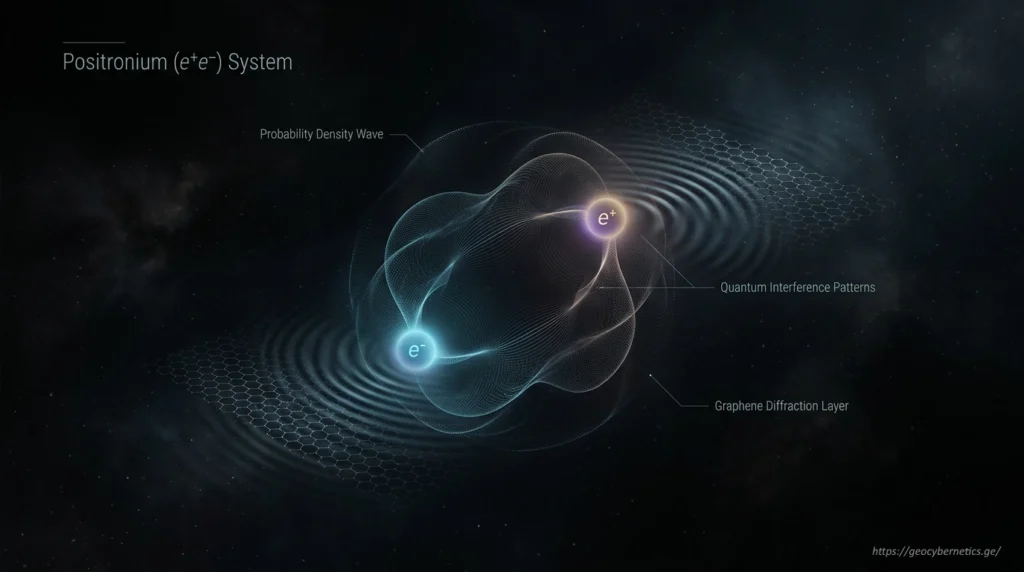
Figure 1. Positronium—The Wave Reflection of Antimatter (Conceptual Quantum Visualization)
The significance of this result is not limited solely to confirming the wave nature of antimatter. Such research could also prove vital for understanding how antimatter interacts with gravity—a question that remains one of the fundamental open problems in modern physics.
3. Superconductivity and Collective Quantum Dynamics
Within superconducting materials, electrons no longer behave independently. At low temperatures, they pair up into Cooper pairs and form a collective quantum state described by the BCS (Bardeen-Cooper-Schrieffer) theory.
Modern visualization techniques have allowed scientists to directly observe the phase-coordinated dynamics present within these systems. In this state, the motion of electrons is no longer chaotic; the system transitions into a unified mode of collective behavior, which gives rise to the unique properties of superconductivity—including the complete disappearance of electrical resistance [3].

These results underscore that superconductivity is not merely a material property. It stands as a prime example of collective quantum organization, where the macroscopic behavior of the system emerges from coordinated quantum interactions between particles.
Synthesis and Perspective
At first glance, quantum teleportation, antimatter interference, and superconductivity describe entirely disparate physical phenomena. However, contemporary experiments indicate that these fields share a common foundation: information, wave descriptions, and collective dynamics are no longer isolated characteristics of quantum systems.
Quantum teleportation shows that the description of information cannot be considered independently of physical states; positronium experiments confirm that wave behavior extends to antimatter; and the collective dynamics observed in superconducting systems demonstrate how quantum correlations can generate macroscopic properties.
The advancement of these fields is poised to exert a significant influence on the development of quantum communication, high-precision sensor systems, superconducting technologies, and future quantum computing architectures. At the same time, such research gradually compels us to re-evaluate how we describe matter, information, and physical interactions at the fundamental level of the universe.
References:
- “A photon was teleported across 270 meters in stunning quantum breakthrough” – ScienceDaily, 2026. https://www.sciencedaily.com/releases/2026/04/260429102030.htm
- “Scientists catch antimatter ‘atom’ acting like a wave for the first time” – ScienceDaily, 2026. https://www.sciencedaily.com/releases/2026/04/260428045612.htm
- “Scientists just captured a mysterious quantum ‘dance’ inside superconductors” – ScienceDaily, 2026. https://www.sciencedaily.com/releases/2026/04/260427050550.htm