
Author: Jano Markhulia
Abstract:
Quantum physics is transitioning from abstract theory toward a phase of targeted engineering. This article analyzes three pivotal breakthroughs published in June 2026: the manipulation of the fifth state of matter in microgravity, the detection of “invisible” altermagnetism, and the control of quantum emitters through moiré architectures. These advancements define the current trajectory of Quantum Revolution 2.0 and its potential for future technological integration.
1. Introduction
Throughout the history of science, there are periods when new discoveries do more than simply expand our knowledge—they fundamentally shift the way we ask questions about the universe. Quantum physics currently stands at such a transformative juncture. If the scientists of the previous century sought to unravel and experimentally verify the paradoxical laws of the quantum world, contemporary research focuses increasingly on the deliberate control of these laws. We are no longer passive observers marvelling at the counterintuitive behavior of atoms, electrons, and photons; we are becoming their architects, laying the foundation for entirely new technological capabilities.
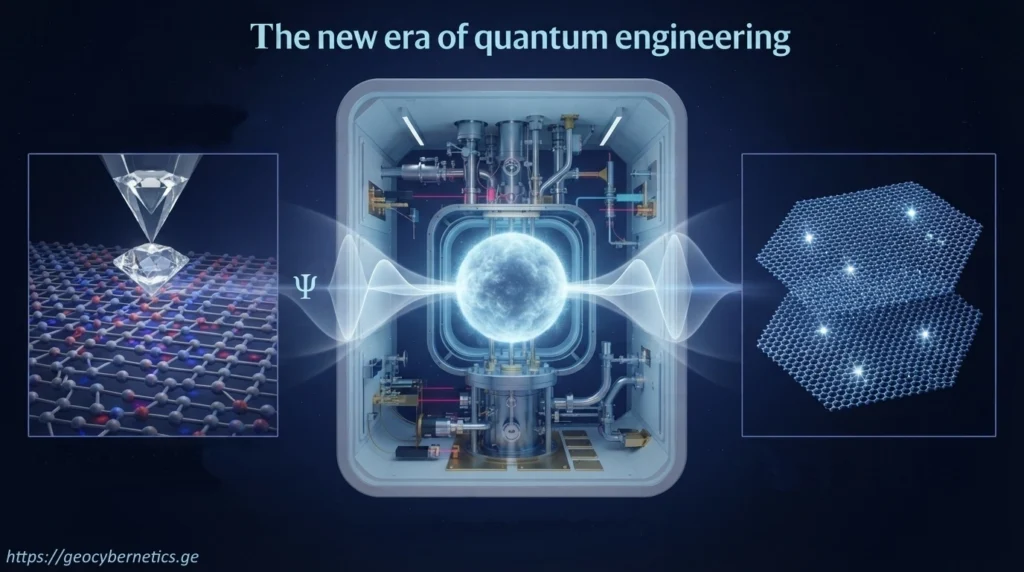
This significant shift is clearly reflected in three independent studies published in June 2026. Each study highlights a different but interconnected aspect of quantum engineering. The first concerns the upgraded capabilities of NASA’s Cold Atom Lab on the International Space Station, where precision control of ultracold atomic quantum states has become possible under microgravity 1 conditions [1]. In this environment, matter transitions into the state of a Bose-Einstein Condensate (BEC) 2. The second study proposes an innovative method based on quantum sensors for identifying altermagnetism 3—a newly discovered class of magnetic materials [2, 3]. The third demonstrates that by slightly adjusting the angle between layers of a two-dimensional material, hexagonal Boron Nitride (hBN) 4, it is possible to precisely control the properties of quantum light sources [4].
At first glance, these studies appear to belong to entirely different scientific disciplines, focusing on different scales, environments, and experimental methods. However, they are united by a single conceptual thread: a drive toward the practical and manageable application of quantum effects rather than mere description. It is through this process that modern quantum technology emerges—a field where fundamental physics is gradually becoming the bedrock of engineering science.
2. Quantum Laboratories in Space: Mastering the Fifth State of Matter in Microgravity
In fundamental physics, Earth’s gravity is often a primary obstacle rather than a facilitating factor. When studying the wave nature of ultracold atoms, gravitational pull causes particles to slump rapidly toward the bottom of the experimental chamber, significantly limiting observation time. To overcome this constraint, NASA developed the Cold Atom Lab (CAL)5, located on the International Space Station (ISS) and operated remotely from Earth.
Following a technical modernization in June 2026, the laboratory opened a new horizon for research. In the microgravity environment of the ISS, atoms can be cooled closer to absolute zero (0 Kelvin, -273.15°C) than is possible on Earth. In this extreme environment, thermal motion is nearly eliminated, and kinetic energy reaches a minimum, allowing scientists to achieve a stable phase of Bose-Einstein Condensate (BEC).
The primary innovation of the upgraded module is a redesigned magnetic trap6. This instrument grants researchers the unique ability to manipulate the shape of ultracold gas clouds at will. Space-based BEC research is a cornerstone of “Quantum Revolution 2.0.7” While the first quantum revolution focused on discovering and utilizing naturally occurring quantum effects (e.g., lasers and transistors), Quantum Revolution 2.0 centers on the direct, artificial control of individual quantum states.
🚀 What is the technological significance?
Experiments in microgravity allow scientists to observe quantum effects that persist for only fractions of a second on Earth. This prolonged study of matter’s wave properties facilitates the refinement of next-generation quantum instruments, which are critical for:
- Autonomous high-precision navigation systems that function without satellite (GPS) signals;
- Unprecedented mapping of Earth’s and the Moon’s gravitational fields;
- Exploring fundamental questions regarding the interaction between quantum mechanics and gravity.
💡 Interesting Fact

The existence of the Bose-Einstein Condensate (BEC) was theoretically predicted in 1924–1925 by Satyendra Nath Bose (1894–1974) and Albert Einstein. However, its experimental realization was not achieved until 1995. This historic breakthrough was awarded the Nobel Prize in Physics in 2001.
3. Altermagnetism and Nanoscale Detection: How Quantum Sensors Work
For decades, macroscopic magnetism was classified into two primary categories: ferromagnetism and antiferromagnetism8. However, recent discoveries have revealed a third, entirely unique class: Altermagnetism. Like antiferromagnets, altermagnets produce no external macroscopic magnetic field, eliminating unwanted interference with neighboring components; yet, like ferromagnets, they possess spin-polarized energy bands. This combination makes them ideal candidates for the future of spintronics.
Until now, the primary challenge has been the identification of these materials, as their lack of an external magnetic field makes them nearly “invisible” to traditional sensors. In a study published in Physical Review Letters in June 2026, researchers proposed an innovative solution: using Nitrogen-Vacancy (NV) centers9 in diamonds to detect altermagnetic order.
🔍 How does this technology work?
Imagine a diamond crystal with a deliberate atomic defect — the NV center. This defect acts as a “quantum compass” sensitive to the smallest magnetic fluctuations in its environment. When this diamond-tipped sensor (cantilever) is brought extremely close (<10 nm) to a material, the microscopic atomic spins within the material influence the sensor’s quantum state.
By applying microwave pulses, scientists “excite” this quantum compass and measure its relaxation time — the duration it takes to return to its initial state. Because altermagnets have a unique, direction-dependent (anisotropic) internal structure, the “compass needle” loses its orientation much faster in certain directions than in others. This timing variance serves as a “quantum fingerprint,” providing undeniable evidence of altermagnetism.
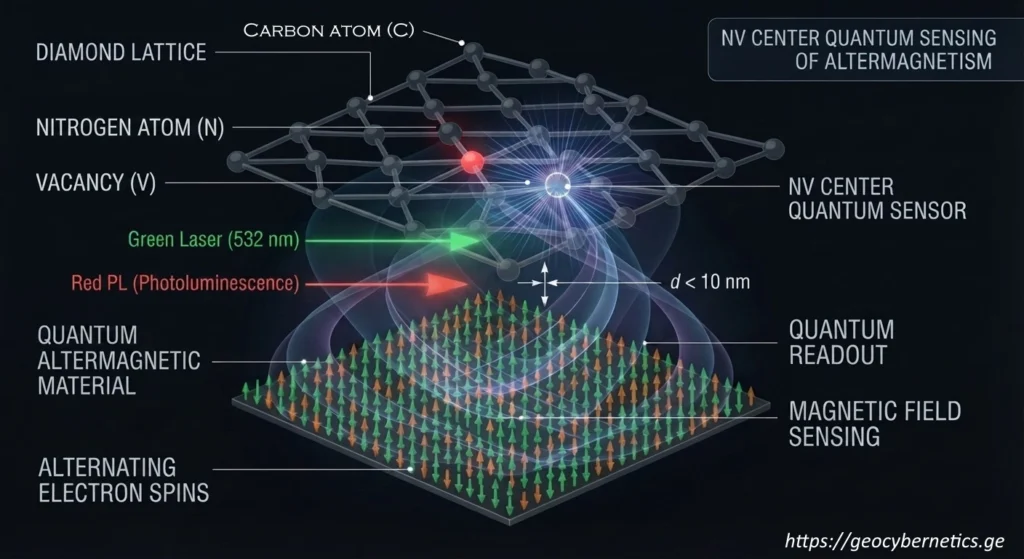
Schematic for the detection of altermagnetic order via an NV center integrated into a diamond crystal lattice. The top-left inset illustrates the atomic structure of the defect, where a nitrogen atom (N) and a vacancy (V) within the diamond (C) crystal lattice matrix form a quantum sensor. The diagram shows the operating principle: a green laser pulse (532 nm) excites the spin state of the NV center, while the resulting red photoluminescence (Red PL) signal evaluates changes in the quantum state. When the diamond nanotip approaches the surface (d < 10 nm), the internal local magnetic field (B) of the altermagnet shifts the sensor’s spin orientation, enabling the high-precision identification of “invisible” magnetic phases.
🚀 What technological breakthrough does this enable?
This approach is fundamental, as it allows for the nanoscale diagnostics of “invisible” magnetic structures without compromising the material’s integrity or requiring invasive interference. This experimental method will significantly accelerate the integration of altermagnets into commercial microchips. As a result, data transfer in computer processors will be radically faster, while thermal energy losses will be minimized.
Detailed scientific data are available in the publication in Physical Review Letters.
4. 2D Materials and Moiré Architecture: Controlling Quantum Emitters
To build quantum information systems and future optical computers, scientists require light sources capable of emitting single photons at strictly defined intervals. Hexagonal Boron Nitride (hBN), a two-dimensional material, is frequently used for this purpose, as defects within its crystal structure act as efficient quantum emitters10. However, precisely controlling and localizing these emitters has remained a significant challenge.
In a new study published in Nano Letters, an international research team introduced an approach based on the Moiré effec11t. By twisting two ultrathin layers of hBN at a specific angle relative to each other, they fundamentally altered the system’s optical and electronic landscape.
The Mechanism:
When two periodic crystal lattices are overlaid at a slight “twist angle,” they create a new, larger-scale structure called a Moiré superlattice12. This new geometry generates localized potential wells (“quantum traps”), which force quantum emitters within the hBN to align at specific spatial points.
This approach transforms the capabilities of quantum optics by providing:
- Optical Tuning: Slight adjustments to the twist angle allow for precise regulation of photon wavelength and intensity.
- Scalable Architecture: This method paves the way for integrating thousands of identical, controlled quantum light sources on a single chip.
- Reduced Decoherence13: The isolation provided by the moiré structure protects emitters from environmental noise, increasing the stability of quantum states.
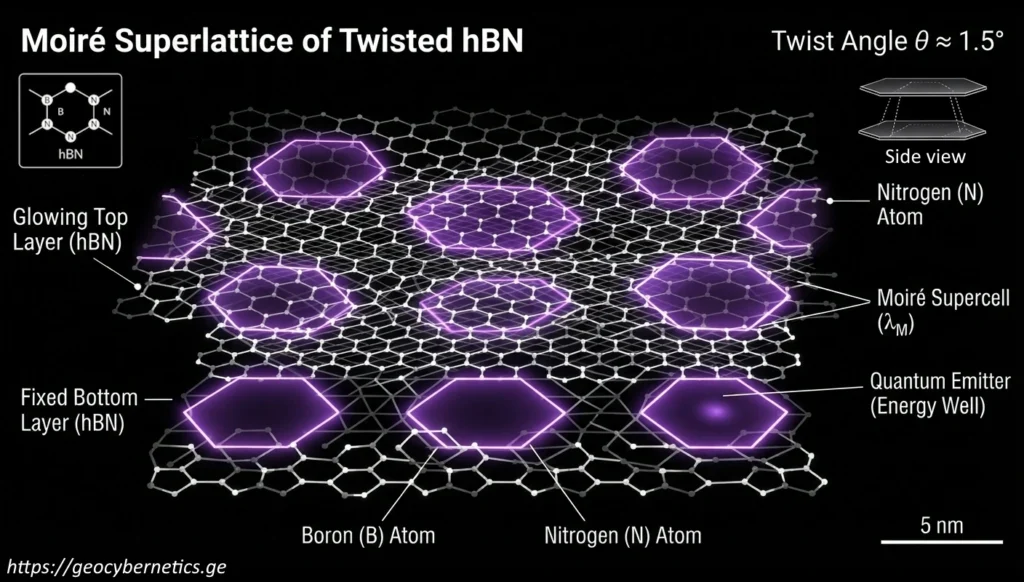
Formation of a Moiré Superlattice through the mutual twisting (θ ≈ 1.5°) of two ultrathin layers of hexagonal Boron Nitride (hBN). The top-left inset shows the atomic lattice of hBN, composed of boron and nitrogen atoms, while the top-right diagram (“side view”) illustrates the spatial arrangement of the layers and the van der Waals interactions between them. Rotating the layers at a small angle creates a new, larger-scale geometric pattern—the Moiré superlattice (λM). This super-structure induces periodic potential wells (quantum emitters) that act as localized quantum traps, ensuring the stable and ordered emission of single photons.
5. Challenges and Future Outlook
While these developments offer revolutionary prospects, they remain in the early stages of development:
- NASA’s Cold Atom Lab: While successful in orbit, practical and commercial applications derived from this platform require extensive laboratory refinement.
- Altermagnetic Detection: The NV-center sensing method currently relies on sophisticated theoretical models; upcoming experimental validation will be crucial for real-world implementation.
- hBN Scalability: The industrial scalability of mechanical twisting (twisteronics) remains an open question for the mass production of quantum processors.
6. Conclusion
Quantum technology is entering a qualitative new phase where the fundamental challenge is no longer just the discovery of quantum phenomena, but their reliable, sustained, and purposeful control. The three independent studies from June 2026 reflect this critical transition. Quantum physics is finally transcending the boundaries of abstract theory to become a discipline of deliberate engineering, shaping the future of global communication, sensing, and computation.
Author’s Note
The analysis provided in this article is based on independent scientific publications and authoritative reviews released in June 2026. A clear distinction is made throughout the text between experimentally validated facts and prospective developments that are currently in the stages of theoretical modeling or early-phase laboratory research.
References:
- NASA’s Cold Atom Lab is creating one of the weirdest forms of matter in space. ScienceDaily, June 22, 2026. Link
- A tiny diamond defect could reveal a mysterious new kind of magnetism. ScienceDaily, June 21, 2026. Link
- V. A. S. V. Bittencourt, Hossein Hosseinabadi, Jairo Sinova, Libor Šmejkal, Jamir Marino. Quantum Impurity Sensing of Altermagnetic Order. Physical Review Letters, 2026; 136 (14) DOI: 10.1103/2ppn-kvjv
- This simple twist could bring quantum computers closer to reality. ScienceDaily, June 20, 2026. Link
- Angus Gale et al., Twist-controlled modulation of quantum emitters in hexagonal boron nitride.Sci. Adv.12,eaec0101(2026). DOI:10.1126/sciadv.aec0101
- Amin, O.J., Dal Din, A., Golias, E. et al. Nanoscale imaging and control of altermagnetism in MnTe. Nature 636, 348–353 (2024). https://doi.org/10.1038/s41586-024-08234-x
- Shawulienu Kezilebieke, Viliam Vaňo, Md N. Huda, Markus Aapro, Somesh C. Ganguli, Peter Liljeroth, and Jose L. LadoNano Letters, 2022 22 (1), 328-333 DOI: 10.1021/acs.nanolett.1c03856
📚 GeoCybernetics Scientific Dictionary and Educational
- Microgravity — A state in which the force of gravity is extremely weak (near-zero), creating an effect of “weightlessness.” In a space station environment, this allows for the prolonged “free fall” of objects, which is essential for sensitive quantum experiments. ↩︎
- Bose-Einstein Condensate (BEC) — A state of matter (often referred to as the “fifth state of matter”) that forms in a gas of bosons cooled to temperatures near absolute zero. At this stage, a large fraction of the particles occupy the lowest quantum state, resulting in quantum effects becoming visible on a macroscopic scale (atoms lose their individual identities and behave as a single quantum system described by a unified wave function). ↩︎
- Altermagnetism — A recently discovered class of magnetic order that combines properties of both ferromagnetism and antiferromagnetism: it possesses no macroscopic magnetic field but is characterized by the spin-splitting of its energy bands. ↩︎
- Hexagonal Boron Nitride (hBN) — An advanced synthetic ceramic material with a layered structure. Due to its crystalline lattice and lubricating properties similar to graphite, it is often referred to as “white graphite.” Unlike graphite, it is characterized by high thermal stability and distinct electrical insulating (dielectric) properties. ↩︎
- NASA’s Cold Atom Lab: While successful in orbit, practical and commercial applications derived from this platform require extensive laboratory refinement. ↩︎
- Magnetic Trap — A device that utilizes magnetic fields to confine and manipulate neutral atoms or particles in space. It is a critical instrument in ultracold atomic physics, metrology, and quantum optics, as it enables the cooling of matter to temperatures near absolute zero and the formation of Bose-Einstein Condensates. ↩︎
- Quantum Revolution 2.0 — The contemporary stage of technological development that involves not only utilizing quantum laws but also the active manipulation and control of individual quantum systems and particles. ↩︎
- Antiferromagnetism — A form of magnetism in which the magnetic moments (spins) of neighboring atoms within a material are aligned in opposite directions (antiparallel). Consequently, these spins cancel each other out, resulting in no external macroscopic magnetic field, making antiferromagnetic materials “invisible” to conventional magnetometers. ↩︎
- NV Center (Nitrogen-Vacancy center) — A point defect in a diamond crystal lattice formed by replacing a carbon atom with a nitrogen atom and the existence of a vacancy (empty space) at an adjacent lattice site. Its spin is extremely sensitive to external factors, making it highly effective as a high-sensitivity quantum sensor for measuring magnetic fields. ↩︎
- Quantum Emitter — A nanoscale system (light source) or crystalline defect capable of emitting single photons one at a time in a strictly controlled manner. ↩︎
- Moiré Effect — An optical effect produced when two similar periodic grid patterns (e.g., crystal lattices) are overlaid while being slightly rotated relative to each other. ↩︎
- Superlattice — A structure formed by the periodic alternation of two or more different materials (or twisted layers of the same material), where the period is significantly larger than the lattice constant of the individual crystals. ↩︎
- Decoherence — The process by which a quantum system loses its quantum properties due to interaction with its environment. Decoherence is a primary obstacle for the development of quantum computers ↩︎