
Abstract
Three independent studies in contemporary biology — deciphering the biosynthesis of toxic plant compounds, identifying a new mechanism involving mobile genetic elements, and detecting previously unknown archaic genetic lineages in the human genome — converge on a common idea: life can be understood as a multilayered system for generating, transmitting, and storing information. This article explores how these discoveries are reshaping our understanding of biology and evolution.
One of the most fascinating characteristics of modern biology is that fundamental breakthroughs are increasingly born at the intersection of vastly different research fields. Today, biology is no longer merely the description of individual organisms; it is increasingly being viewed as an information science, deciphering the complex codes of the natural world.
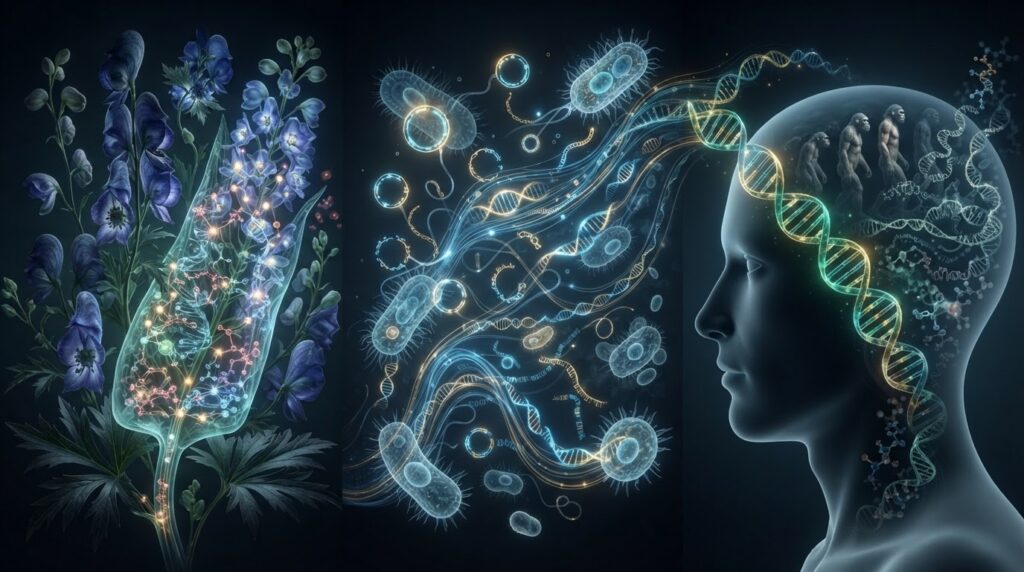
While one study explores the intricate chemical “laboratories” of poisonous plants, another investigates the unexpected routes of genetic instructions within the genome, and a third uncovers an evolutionary history spanning millions of years hidden in our DNA. Despite their thematic differences, the three studies converge on a common question: how biological information is generated, transmitted, and stored.
1. Reconstructing the Plant Biosynthetic Program
Plants are nature’s master chemists. Over millions of years, they have developed a molecular arsenal, many of which have found applications in medicine. However, the mechanisms underlying these internal ‘laboratories’ has long remained a mystery.
A study published in the journal Molecular Plant describes how scientists have elucidated the initial stages of the biosynthesis of diterpenoid alkaloids1— complex and toxic compounds. The primary achievement of this research is not simply the production of a specific molecule, atisinium2, but the identification of the six enzymes that manage this sophisticated biochemical assembly line.
💡 Interesting Fact

Plants such as Aconite (Aconitum) have historically been used to poison arrows. According to the study’s authors, the significance of this work is currently at the level of fundamental biochemistry—no specific drug has been created yet, and atisinium has not been tested as a therapeutic agent. However, decoding this "genetic software" paves the way for controlling this toxic potential in a safe and sustainable manner (e.g., through genes transferred into yeast), which in the future will facilitate the search for new compounds against cancer and other diseases.
2. Mobile Genes: New Routes for Genetic Information Transfer
Genetic information is not always passed down strictly from parent to offspring. Horizontal Gene Transfer (HGT)3—the process by which genes move between different species—is one of the most powerful engines of evolution. Until now, it was believed that viruses or plasmids were the primary “carriers” of this information.
However, researchers at the Max Planck Institute have discovered a previously unknown mechanism: circular intron RNA4. While studying a tiny predatory bacterium, the researchers found that segments of its RNA form stable rings that are resistant to degradation. Using specialised microscopic methods, researchers detected this RNA not only within the predator’s cells but also inside the dead cells of its prey—an archaeon.
This is the first direct observation of such a mobile genetic element physically reaching the cells of another species without a viral or plasmid carrier. At the same time, it is worth noting that this is an early-stage observation: the study confirmed the transfer of RNA into dead cells, but it has not yet been fully proven that this RNA actually integrates and functions within the genome of a new, living host. This will be the subject of the next phase of research—a distinction that does not diminish the discovery’s importance but accurately reflects the boundary between established knowledge and current hypothesis.
💡 For Context

Circular RNA molecules are much more stable because they lack "open ends" for cellular enzymes to latch onto and degrade. This makes them ideal long-distance carriers of biological information.
3. Genomic Archaeology: Invisible Genetic Lineages in Our DNA
The human genome is more than a set of biological instructions; it is a massive archive. Scientists at UC Berkeley, using a new method called TRACE (TRacking Archaic Contributions via ARG Estimation), have effectively conducted a form of genomic archaeology.
The study revealed genetic signals that belong neither to Neanderthals nor to Denisovans. These signals point to two previously unknown extinct archaic lineages (“Ghost lineages”)5:
- One lineage that diverged from our ancestors approximately 800,000 years ago and accounts for about 0.5–1% of the modern human genome.
- Another, even older “super-archaic” lineage, approximately 1.8 million years old, whose traces entered our genome through interbreeding with Denisovans6.
This discovery shows that human history is not a simple tree but a complex, interconnected web. Our DNA preserves information about species for which we possess no physical fossil record.
💡 Scientific Context

Approximately 1% of modern human DNA comes from these "ghost" ancestors. Our genome is effectively a complex mosaic of genetic data from various ancestral human species.
🔬 GeoCybernetics Perspective

Biology and cybernetics are united by a single fundamental idea — the organisation, management, and interconnectedness of systems. The aforementioned studies demonstrate that the informational network of life simultaneously creates and transforms biological code, transmits it, and preserves evolutionary traces: in plants through biosynthetic pathways, in bacteria via genetic information transfer, and in human evolution in the form of a genomic archive.
Conclusion
Thus, all three studies lead to a common conclusion: nature creates, transforms, transmits, and stores information with incredible efficiency. Modern technologies — metabolic reconstruction, structural RNA analysis, and computational genomics7 — allow us not only to observe life but to gradually uncover the informational principles upon which it operates. We are no longer mere passive observers; we are gaining the ability to understand more deeply and partially manage biological systems, in which every genome, molecule, and biological mechanism is a carrier of information accumulated over billions of years of evolution.
References:
- Miller, G. P., Mutabdžija-Nedelcheva, L., Andersen, T. B. et al. Characterization of the entry steps in diterpenoid alkaloid biosynthesis. Molecular Plant (2026). DOI: 10.1016/j.molp.2026.05.022
- Kizina, J., Lonsing, A. & Harder, J. Mobile intron RNA from a bacterial predator accumulates in dead archaeal cells. Scientific Reports 16, 14654 (2026). DOI: 10.1038/s41598-026-51721-6
- Zhang, Y. et al. Recovering signatures of archaic hominin introgression using ancestral recombination graphs. Science (2026). DOI: 10.1126/science.aef8874
📚 GeoCybernetics Scientific Glossary & Educational Notes
- Diterpenoid Alkaloids: Complex nitrogen-containing compounds of plant origin characterised by strong biological activity (often toxicity) and used in pharmacology.
↩︎ - Atisinium: A complex organic compound belonging to the diterpenoid alkaloid group. It occurs naturally in poisonous plants of the genera Aconitum and Delphinium. Biologically, it is important as a key intermediate, because elucidating the pathway of its biosynthesis has enabled scientists to understand, for the first time, how the “biochemical assembly line” within plant cells constructs such complex and toxic molecules.
↩︎ - Horizontal Gene Transfer (HGT): The transfer of genetic material between organisms that do not have a parent-offspring relationship. This process is particularly common in microorganisms.
↩︎ - Circular Intron RNA (ciRNA): A type of single-stranded non-coding RNA formed from introns during the splicing process. Due to its circular structure (lacking free 5′ and 3′ ends), it is highly resistant to enzymatic degradation. Beyond regulating the transcription of parent genes, recent research suggests ciRNA can act as a stable vector for the horizontal transfer of genetic information (mobile elements) between different species. ↩︎
- Ghost Lineages (Archaic Ghost Populations): Evolutionary lineages inferred to have existed based on mathematical and genomic modeling, despite the lack of direct physical evidence such as fossils or sequenced ancient DNA (aDNA). In the context of biological cybernetics, these are viewed as “informational footprints” within the genome—genetic code inherited from an unknown source that does not match any known reference genomes (e.g., Neanderthals or Denisovans). Identifying a ghost lineage is akin to finding fragments of an external code within a software system, proving the existence of a prior “author” of whom no other records remain.
↩︎ - Denisovans: An extinct group of archaic humans who inhabited Asia, predominantly during the Middle Paleolithic (from approximately 370,000 to 30,000–50,000 years ago). They were first identified in 2010 through DNA analysis of small fragments discovered in the Denisova Cave in Siberia. This discovery is revolutionary as Denisovans are the first human group to be identified almost entirely through their “genetic archive” (DNA) rather than fossil morphology. They shared a close evolutionary relationship with both Neanderthals and modern humans (Homo sapiens), as evidenced by the genetic legacy they left in our genome.
↩︎ - Genomics: A branch of biology focused on the study of complete genomes—the entire structure, function, evolution, and mapping of an organism’s DNA. Unlike classical genetics, which typically investigates individual genes and their roles in inheritance, genomics analyzes the genetic material of an organism simultaneously and as a whole. ↩︎